Annual Reports
PT Metrodata Electronics Tbk's annual reports contain management's most considered account of the business. These are the sections, passages and visual pages worth opening in the originals preserved in Sources.
PT Metrodata Electronics Tbk — 2025 Annual & Sustainability Report — FY2025
The latest annual report: management's fullest account of a distributor-plus-solutions ICT group navigating weak Indonesian demand while pivoting to AI. · Open the full document →
Directors' Report — p. 18 · Read the full section →
Management's own read on the year — the AI-pioneer strategic pivot and the headline 2025 result set the frame for everything below.
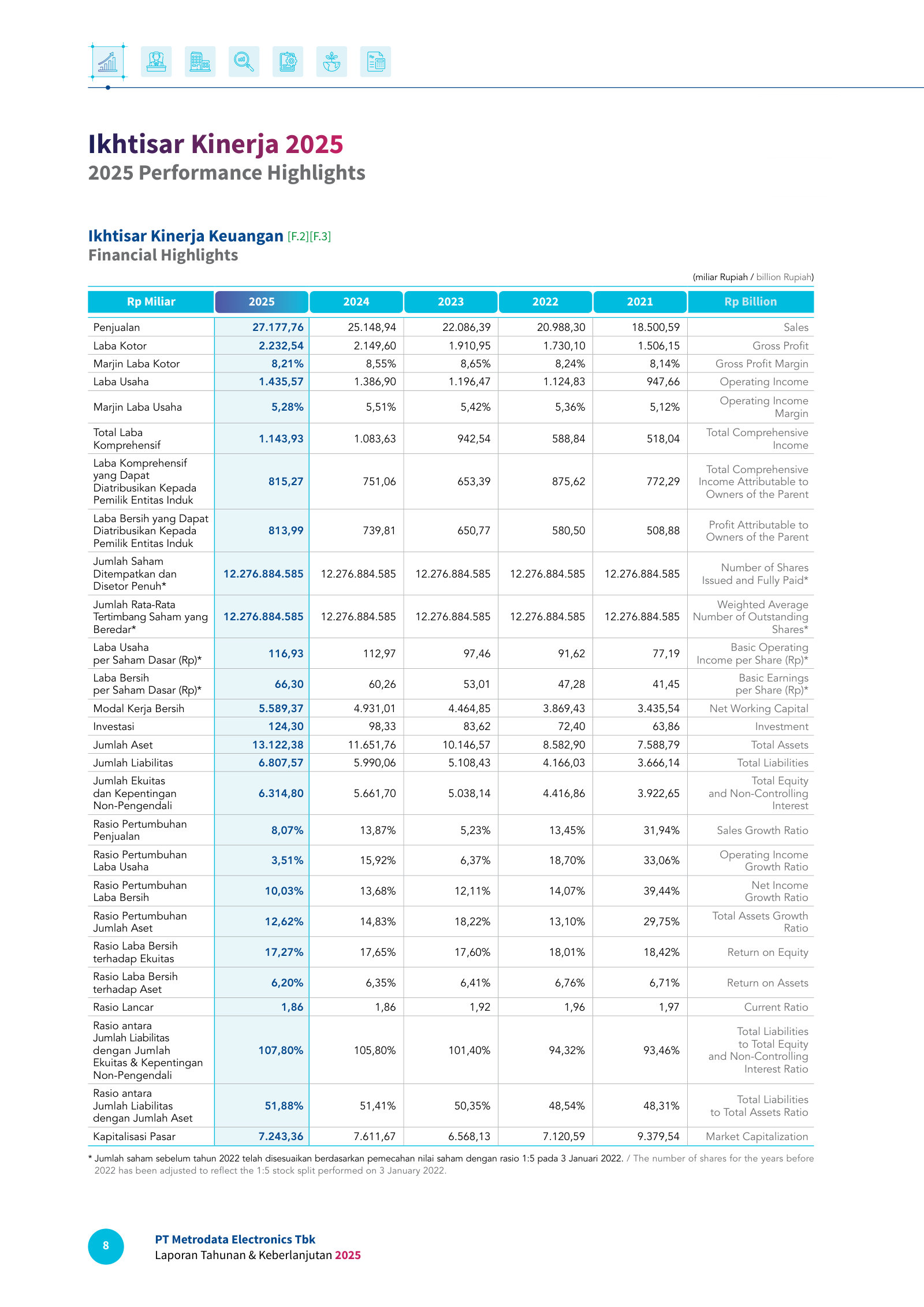
2025 result: revenue Rp27.2tn (+8.1%), net profit to owners Rp814bn (+10.0%), 1.1x liabilities-to-equity.
For the 2025 financial year, the Company recorded revenue of Rp27.2 trillion, representing an 8.1% increase compared to 2024. Net profit attributable to owners of the parent entity grew by 10.0% to Rp814 billion, which translates to greater value delivered to our shareholders. The Company’s financial position remained robust, as reflected by total equity of Rp6.3 trillion and a liabilities-to-equity ratio of 1.1x, providing a solid foundation to support sustainable growth in the future.
p. 21 · Read in context →
Business Activities and Operational Areas — p. 32 · Read the full section →
The clearest statement of what the company actually is — two businesses, Eight Pillars of solutions, and 100+ distribution principals.
The two engines: Digital Solutions & Consulting (Eight Pillars) and a 100+ principal Digital Distribution network.
Currently the Company operates two main businesses, namely Digital Solutions & Consulting and Digital Distribution.
Through its Digital Solutions & Consulting business, Metrodata delivers end-to-end digital transformation services across its Eight Pillars of Digital Solutions: Cloud, Data & AI, Cybersecurity, Business Application, Digital Business Platform, Hybrid AI Infrastructure, Consulting & Advisory Services, and Managed Services. […] Metrodata’s Digital Distribution business has been solidifying its reputation as the most comprehensive ICT distributor in Indonesia. It forges collaboration with over 100 global principals. Throughout its network, the Company serves thousands of partners across hundreds of cities nationwide.
p. 33 · Read in context →
Analysis of Consolidated Statements of Profit or Loss — p. 63 · Read the full section →
Where management explains what actually moved the numbers — smartphones carried a soft consumer-hardware year.
Operational Review — p. 71 · Read the full section →
Segment-by-segment detail — the high-margin solutions unit and the volume-driven distribution unit each get their own diagnosis.
Solutions & Consulting: reactivating dormant accounts and leaning on hyperscaler partnerships for cloud growth.
The Company established dedicated teams tasked with re-mapping thousands of customer accounts considered dormant. Through these efforts, relationships with accounts that had been inactive for the past two to three years were successfully reactivated. […] To address this need, the Company leveraged its strong position as a primary partner of the three largest hyperscalers globally.
p. 72 · Read in context →
Distribution: telecom/smartphones offset a pressured consumer PC segment as the year's growth engine.
The Consumer segment faced the most monumental pressure arising from weakened demand for notebooks and PCs since the beginning of the year. […] In contrast to the weakening demand trend, the Telecommunications segment emerged as a key growth driver for the Digital Distribution Business Unit in 2025. Smartphone sales volume rose steeply, dominated by devices in the low to lower-mid price tiers, even as they came with strong specifications that gave them a competitive edge.
p. 76 · Read in context →
Risk Management — p. 114 · Read the full section →
The two risks specific to this business that could genuinely bite: scarce ICT talent and imported-hardware FX exposure.
Talent risk: growth hinges on retaining scarce ICT experts who must keep pace with fast-moving technology.
In realizing the ICT and digital business development plan, the Company relies on competent, skilled, and expert talents for its business growth. Should the Company fail to retain its executives and experts, a high turnover of employees may occur as a result. Subsequently, should the Company fail to recruit new employees as the replacements, the Company’s performance may be affected, and its revenues may be potentially reduced. […] In addition, the inability of the Company’s employees to keep abreast of the latest market developments in the ICT field may result in the Company marketing products and services that are no longer relevant or attractive to the consumers.
p. 114 · Read in context →
FX risk: much of the product slate is foreign-branded, so a stronger dollar can price demand out of the market.
Certain ICT products offered by the Company are sourced from principals in foreign countries and thus their prices are linked to certain exchange rates. Although some of the principals have set up representative offices in Indonesia and therefore are selling their products in Rupiah, changes in prices that may result from the strengthening of certain foreign currencies may result in a decline in the demand for these products.
p. 115 · Read in context →
Note 2r — Revenue and Expense Recognition — p. 210 · Read the full section →
The accounting policy that defines the model: when Metrodata books gross (principal) versus net (agent) revenue.
Principal vs. agent: third-party/cloud licenses booked net as agent; otherwise revenue is gross as principal.
In arrangements with customers where software licenses are delivered entirely by third party, or where the updates and cloud access are critical and there are no material onpremise components in satisfying its performance obligation, the Group will recognise revenue on a net basis as the Group is acting as an agent in the transaction. In all other cases, the Group is deemed to be acting as principal and revenue is recognised on a gross basis.
p. 210 · Read in context →
Note 25 — Segment Information — p. 243 · Read the full section →
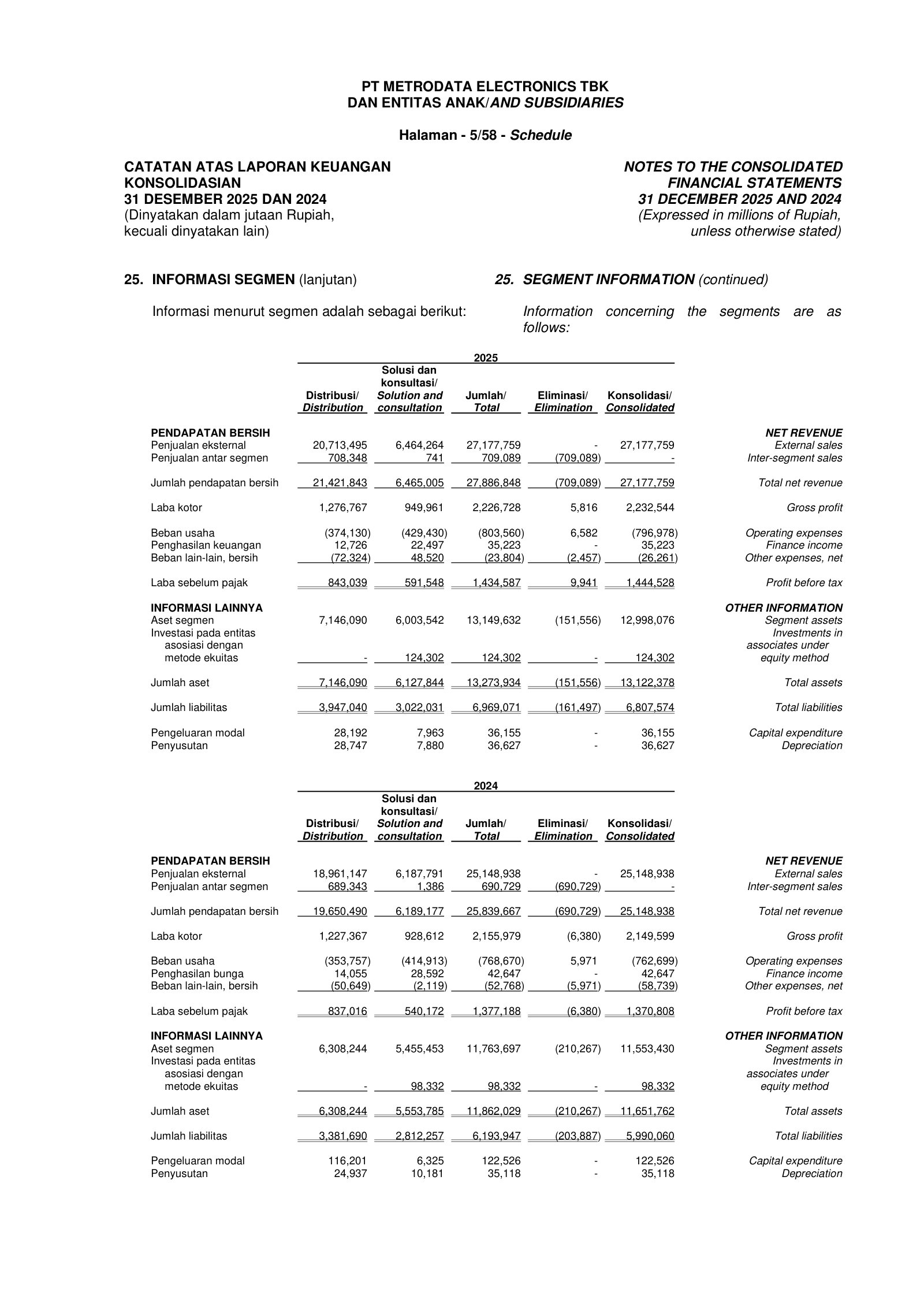
The whole business model in one table: high-volume/thin-margin Distribution against smaller/richer-margin Solutions.
More annual reports
PT Metrodata Electronics Tbk — 2024 Annual & Sustainability Report — FY2024 · 263 pages · Prior-year edition: the +13.9% revenue and +15.9% operating-income growth that 2025's softer print is measured against. · Open →
PT Metrodata Electronics Tbk — 2023 Annual & Sustainability Report — FY2023 · 255 pages · Two years back, pre-AI-pioneer framing — useful baseline for the same two-segment structure and Eight Pillars. · Open →